 Tiếng Việt
  English
 Agricultural land prices in Ho Chi Minh City are projected to increase at nearly three times the rate of residential land.
According to the adjusted land price framework, agricultural land has increased on average by 11–14 times, while residential land has risen by 4–5 times, helping to reduce the disparity when converting land use purposes.
This information was provided by the Department of Natural Resources and Environment while explaining issues surrounding the draft adjusted land price list currently under public consultation.
The revised price list adds 557 more streets compared to the one implemented under Decision No. 02 issued in 2020 (covering 4,008 streets). Accordingly, land prices in many areas are expected to rise on average by 5–10 times, with some suburban and outlying areas projected to increase by 15–50 times compared to current levels (excluding the land price adjustment coefficient K of 3.5). The department noted that if the K coefficient is included, land prices would increase by about 2.5 times compared to Decision No. 02 issued in 2020 and would reach approximately 70% of market value.
Meanwhile, according to the Department of Natural Resources and Environment, agricultural land prices in Ho Chi Minh City have seen a much sharper increase under the adjusted framework. Under Decision No. 02, depending on location, agricultural land prices ranged from VND 86,400 to VND 300,000 per square meter in various districts. These figures have now risen to several million VND per square meter, representing an average increase of 11–14 times.
A section of Cu Chi District. Photo: Quynh Tran
Specifically, in Thu Duc City, agricultural land prices under the adjusted framework range from VND 4.5 to 6.7 million per square meter, marking an increase of 20.3–30.6 times. In the remaining districts—Districts 12, 7, 8, Binh Tan, Binh Thanh, Go Vap, Tan Binh, and Tan Phu—agricultural land prices now range from VND 5.5 to 9.9 million per square meter, reflecting increases of 33–35 times.
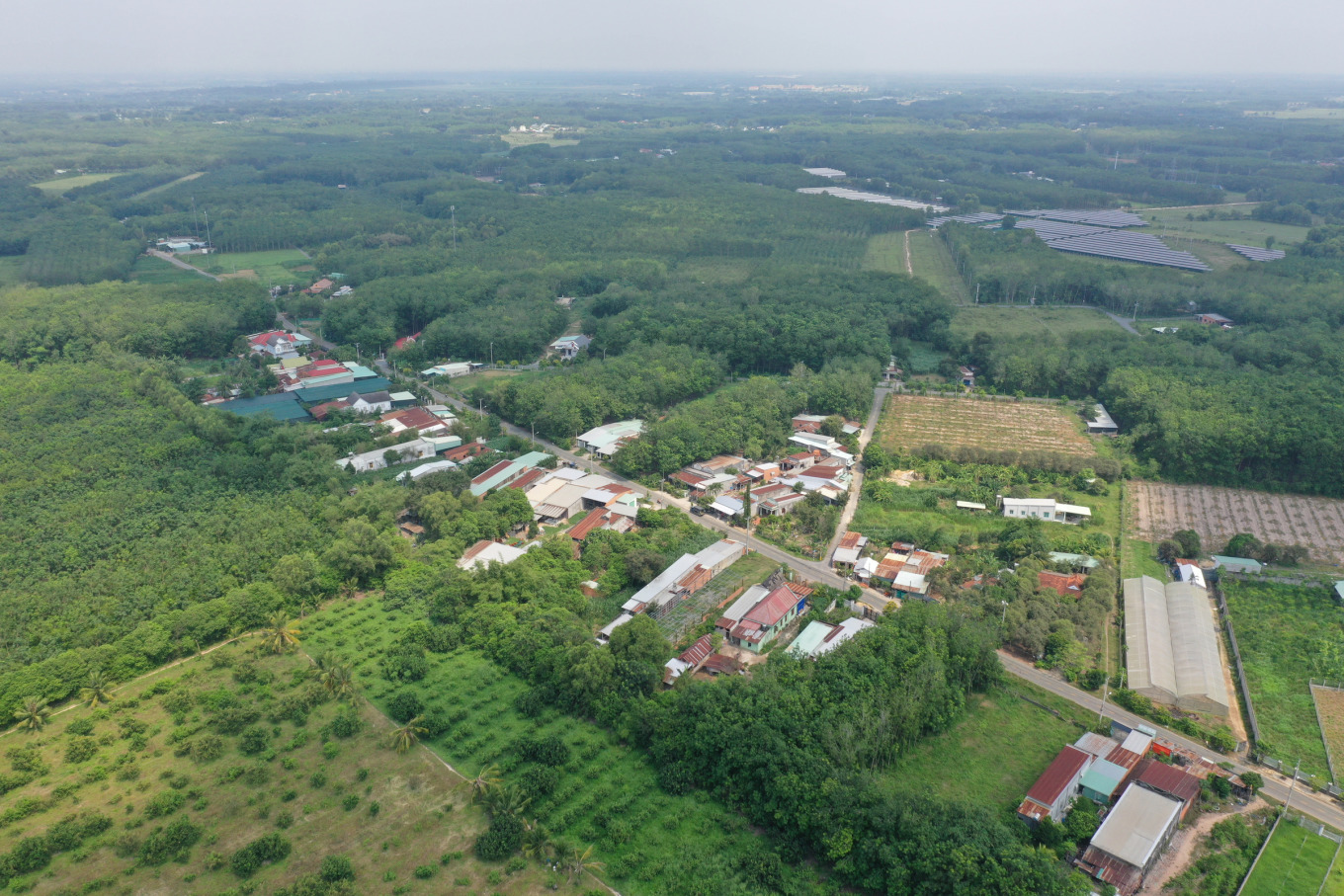
In Cu Chi District, agricultural land prices are adjusted to VND 850,000 to VND 2.88 million per square meter, representing an increase of 6.4–12.5 times. In Hoc Mon District, the adjusted prices range from VND 1.5 to 3.6 million per square meter, equivalent to an increase of 11.3–15.7 times.
In Binh Chanh District, agricultural land prices are adjusted to VND 1.4–3.6 million per square meter, corresponding to an increase of 10.5–15.7 times.
According to the Department of Natural Resources and Environment, when individuals own agricultural land and wish to convert it to residential land, they must pay land use fees equal to the difference between the land price of the new purpose (residential land) and that of the previous purpose (agricultural land). Under the adjusted land price framework, agricultural land prices have increased at a higher average rate (11–14 times) compared to residential land (4–5 times), thereby gradually reducing the amount payable by residents.
Land statistics for 2023 in Ho Chi Minh City show that households and individuals affected by land-use conversion fall into three groups. Among them, nine districts and Thu Duc City have a total agricultural land area of nearly 110,091 hectares. Specifically, District 12 has 1,133 hectares, Tan Phu 27.9 hectares, Binh Tan 854 hectares, and Nha Be District 4,624.1 hectares. In addition, Cu Chi District has 31,127.7 hectares of agricultural land, Hoc Mon District over 5,235 hectares, Binh Chanh District 16,555 hectares, while Can Gio District and Thu Duc City have more than 46,975 and 4,558 hectares respectively.
Seven districts that still have agricultural land but are not affected due to being within project boundaries include Districts 6, 7, 8, 11, Binh Thanh, Go Vap, and Tan Binh. Another six districts—Districts 1, 3, 4, 5, 10, and Phu Nhuan—are also unaffected as there is no remaining agricultural land in these areas.
Ho Chi Minh City has established an appraisal council to review and evaluate the adjusted land price list before it is officially approved by the city’s People’s Committee. If approved, this price list will be applied until December 31, 2025; however, it will still be reassessed later this year to align with economic conditions.
From early 2026, Ho Chi Minh City will implement a new annual land price framework in accordance with the Land Law 2024. The new land price list, effective from January 1, 2026, will follow a different process and must be approved by the Ho Chi Minh City People’s Council.